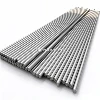
The outstanding properties of titanium, such as high strength, good corrosion resistance and biocompatibility, make it and its alloys popular materials in the aerospace, medical, and chemical industry sectors. Further, the product reliability is directly dependent upon quality of the welds. Titanium; 1 the process(es) employed for the welding of titanium parts are predominately MIG (Metal Inert Gas) and TIG (Tungsten Inert Gas). While the core material of the welding wires in both the solutions is the titanium alloy, the differences in structural design, way of working and compatibility with performance characteristics are rather big. The following is a more detailed, multi-dimensional analysis.
Products Description
| Welding Type | Wire Grade | Diameter Range (mm) | Suggested Applications | Key Features |
|---|---|---|---|---|
| TIG | GR1 | 0.8 – 2.0 | Thin-wall chemical tubing, aerospace components, precise welds | Low heat input, smooth welds, low spatter, excellent surface finish |
| TIG | GR2 | 0.8 – 2.4 | General industrial piping, chemical equipment | Good ductility, corrosion-resistant, precise weld |
| TIG | GR5 (Ti-6Al-4V) | 1.0 – 4.0 | Aerospace parts, marine equipment, pressure vessels | High strength, stable arc, low oxidation |
| TIG | GR23 | 0.8 – 3.0 | Medical implants, surgical instruments | Biocompatible, high corrosion resistance, high strength |
| MIG | ER Ti-1 | 1.0 – 2.0 | Thick chemical pipes, marine structures, general industrial welding | Fast welding, high deposition rate, suitable for mechanized/automated welding |
| MIG | ER Ti-2 | 1.0 – 2.4 | Chemical reactors, heat exchangers, pressure vessels | Medium strength, corrosion-resistant, suitable for large-area welding |
| MIG | ER Ti-5 (Ti-6Al-4V) | 1.2 – 2.4 | Aerospace assemblies, structural components | High strength, good weld penetration, suitable for thick materials |
| MIG | ER Ti-23 | 1.0 – 2.4 | Medical devices, surgical tooling, implant assemblies | Biocompatible, corrosion-resistant, suitable for moderate thickness |
Notes:
TIG wires are preferred for precision, thin-wall, high-quality welds; MIG wires are preferred for high-speed, thick material, automated welding.
Diameter ranges are typical; actual wire diameter selection should match material thickness and welding requirements.
ER = Electrode Rod for MIG welding.
1.Differences Between the Mechanisms and the Functions of Welding Wire In MIG welding, titanium wire also acts as the "electrode" and the "filler metal". The wire tip is melted by the flow of current into droplets which are protected by inert gas (normally argon) against atmosphere and moving towards the molten pool the droplets and molten pool are protected against atmosphere contamination. The fundamental nature is that the wire is actively involved in delivering and melting which allows a continuous and effective welding.In contrast, in TIG welding, titanium wire functions solely as the "filler metal." The conductive electrode is a non-melting tungsten electrode, and current passes through the tungsten to generate an arc that melts the base metal and the filler wire, again relying on argon protection. The most fundamental difference between the two lies in the fact that MIG welding wire is one of the current carriers, whereas TIG welding wire lacks conductive functionality and only provides the amount of weld filler.
2.Variations in the structure and gauge of welding wire. MIG Titanium Welding Wire - Mesh Welding Supply MIG Titanium Solid Core Wire Diameter: 0. Now, with this solid-core structure, both the TIG and MIG welding are well recommended for titanium. The surface must be heavily degreased and deoxidized and the packaging must be sealed with argon to avoid oxidation during storage.Due to the need for stable continuous wire feeding, its straightness and diameter tolerance requirements are extremely high, as uniform wire diameter directly impacts feeding smoothness and droplet transition stability. TIG titanium welding wire is available in solid-core and flux-cored types (with solid-core being the mainstream), featuring a wider diameter range (0.6-2.4 mm). While the straightness requirements are slightly lower than those for MIG welding wire, the surface cleanliness standards remain equally stringent-titanium readily reacts with oxygen, nitrogen, and hydrogen at high temperatures to form brittle compounds, and even minor oxide layers on the wire surface can lead to weld cracking.
3. Welding Performance and Suitable Application Scenarios. In terms of welding efficiency, MIG titanium wire offers significant advantages. The continuous wire feeding mode enables a welding speed 2-3 times that of TIG welding, making it suitable for batch welding of medium-thick plates (2-10mm) titanium alloys, such as large components like aircraft engine casings and chemical pressure vessels. However, MIG welding has a larger molten pool, slightly lower seam formation precision, and a relatively wider heat-affected zone, resulting in poorer adaptability for thin-walled parts.Characteristics of TIG titanium wire welding include stable arc, good controllability of molten pool, beautiful and high precision formation of welding bead and narrow heat affected zone. It is more suited for thin wall (0.5-3mm) parts, precision parts such as Ti Alloy Implants in Medical Devices and Special Joints. However, the slower welding speeds do not allow for high-volume production needs.
4, Comparison of operational requirements and cost-effectiveness. In terms of operational difficulty, TIG titanium wire welding requires higher technical requirements for welders, requiring precise control of wire filling speed, arc length, and gun handling techniques to avoid defects such as incomplete fusion and wire clamping; MIG welding has a higher degree of automation (such as robot welding) and a lower threshold for manual operation. It only requires controlling the wire feeding speed and welding voltage. In terms of cost, the production process of MIG welding wire (such as high-precision drawing and sealed packaging) makes its cost higher than that of ordinary TIG solid core welding wire. The production process of TIG solid core titanium welding wire is relatively simplified, without the need for strict continuous wire feeding adaptability design. The packaging cost is also lower, and the unit price of a single welding wire is more advantageous.
In general, the distinction between MIG and TIG titanium welding wire is in the different characteristics of the welding process that they are suitable for, and one is not inherently better or worse than the other. In application, one has to take into account all factors rather than selecting based on a single aspect, for example thickness, precision, production batch and expense of welding parts.When pursuing efficient batch production and welding medium and thick plates, MIG titanium welding wire is a better choice; TIG titanium welding wire can better meet the requirements of welding precision, thin-walled parts or precision components. In the future, with the upgrading of welding technology, the adaptation scenarios of the two may be further expanded, but the core differences will still revolve around the three core dimensions of efficiency, accuracy, and cost.
Request a Quote
Email:bjcxtitanium@gmail.com
Whatsapp:+8613571718779