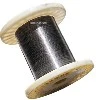
Many buyers ask during inquiries, 'Can we make 0.05mm?'? "
But the real problem is not whether it can be done, but whether it can be done steadily.
The manufacturing of ultrafine titanium wire is essentially a process of constantly approaching its limit.
In conventional sizes (such as 0.5mm and above), wire drawing is more of a mechanical process. But when the size drops below 0.1mm, the problem begins to become more complex:
The first is the limit of the material itself.
Although Ti-6Al-4V ELI has good toughness, it is still a high-strength alloy. During the multi pass cold drawing process, if the annealing control is not good, microcracks are easily generated.
The second issue is the mold problem.
The precision requirement for pulling a 0.05mm mold is already close to the micrometer level. Any slight wear and tear can lead to:
Diameter fluctuation
surface scratch
Ellipticity exceeds the tolerance
The third is surface quality.
Medical titanium wires should not have defects that are not visible to the naked eye, as these defects may become sources of fatigue after implantation. Especially in neural or vascular applications, surface roughness directly affects safety.
That's also why high-end customers often pay extra attention to:
Is it electropolishing
Is the surface Ra value stable
Is there microcrack detection available
The fourth is stability, not a single success.
Many factories can produce a batch of 0.05mm, but cannot do continuous production. This is a fatal issue for medical clients as they require long-term supply rather than samples.
A truly competitive supplier generally has three points:
Multi pass progressive drawing process
Precision annealing control capability
Medical grade mold management system
So if you are in sales, you can directly focus on one point:
The customer is not buying '0.05mm titanium wire', but 'stable 0.05mm capability'.
Request a Quote
Email:bjcxtitanium@gmail.com
Whatsapp:+8613571718779