In the international trade and technical specifications for titanium materials, ASTM and AMS are two sets of authoritative standard systems that appear frequently, but have significant differences in positioning and content. If the purchaser and engineering technicians have insufficient understanding of the differences, it may result in cost waste or engineering risks due to mismatched material properties. Understanding the "personality" and "background" of these two sets of standards is the first step towards precise technical communication and reliable procurement.
ASTM: Targeting a wide range of industrial standards
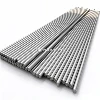
The core characteristics of ASTM (American Society for Testing and Materials) standards are their universality and foundational nature. It is like the "constitution" of titanium properties, establishing the most widely recognized chemical composition range, basic mechanical performance thresholds (such as tensile strength, yield strength, elongation), and conventional testing methods for commercial pure titanium and various titanium alloys. ASTM standards (such as ASTM B348 for titanium rods) cover almost all product forms from raw materials to semi-finished products - plates, rods, tubes, wires, forgings, etc.
Its development logic is to meet the basic needs of most industrial scenarios. For example, chemical equipment manufacturers purchase seamless titanium pipes for heat exchangers based on ASTM B337, with a focus on their standard corrosion resistance and sufficient strength. The ASTM standard provides a fair and universal "technical language" for trade between different countries and suppliers, ensuring that buyers and sellers have a unified cognitive framework for the basic properties of materials. However, it usually does not specify a specific production process path, leaving manufacturers with greater flexibility.
AMS: Advanced specifications derived from aviation

AMS (Aerospace Materials Specification) has completely different genes. It was born out of the aviation industry's stringent requirements for ultimate reliability and performance consistency. If ASTM defines' what is', then AMS focuses more on specifying 'how to do' and 'what level of detail quality must be achieved'.
The requirements of AMS standards for materials go far beyond chemical composition and room temperature mechanical properties. It usually includes a series of deeper and stricter control items, such as:
Microstructure requirements: Clearly define the type of metallographic structure (such as equiaxed alpha structure) and grain size level, as the structure directly affects key indicators such as fatigue performance and fracture toughness.
More comprehensive performance data: In addition to room temperature performance, high temperature performance, fatigue performance (S-N curve), fracture toughness (KIC) and other data are often required.
Strict process and traceability control: There are mandatory regulations on the melting method (such as using a vacuum consumable arc furnace for melting and specifying the melting times) and heat treatment system (precise temperature, time, cooling rate). At the same time, a complete material traceability chain is required, from ingots to finished products, and batch information must be clear and traceable.
Therefore, the degree of control in the production process, completeness of performance data, and quality consistency of a titanium material that meets AMS standards are usually higher than those of materials of the same grade that only meet ASTM standards. Its price naturally reflects this additional 'guarantee'.
Selection logic: applicability is the best
After understanding the difference between the two, the selection logic becomes clear:
Choose ASTM: When your application belongs to the general industrial field (such as chemical, marine, power, general machinery manufacturing), and the project mainly relies on the basic corrosion resistance and conventional strength of materials, materials that meet ASTM standards are a completely sufficient and economical choice. Forcing AMS standards in this scenario is equivalent to equipping ordinary commuter cars with racing engines, which is an unnecessary cost waste.
Choose AMS: When your application involves aerospace, defense, high-end medical implants, or critical load-bearing components with extreme requirements for fatigue life and reliability, the additional control dimensions (organization, process, scalability) provided by AMS standards are necessary guarantees to ensure foolproof performance. It is a designated action to deal with high-risk, high value-added scenarios.
In a nutshell, ASTM is the "everyday language" in industry, while AMS is the "technical language" in high-end manufacturing. Effective sourcing starts with choosing the appropriate technical language for the right application, steering clear of the defaults of "high configuration, low usage" or "low configuration, high usage," and balancing safety, reliability, and cost best.
Request a Quote
Email:bjcxtitanium@gmail.com
Whatsapp:+8613571718779