


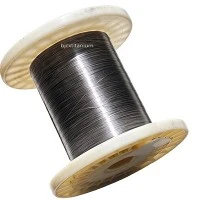

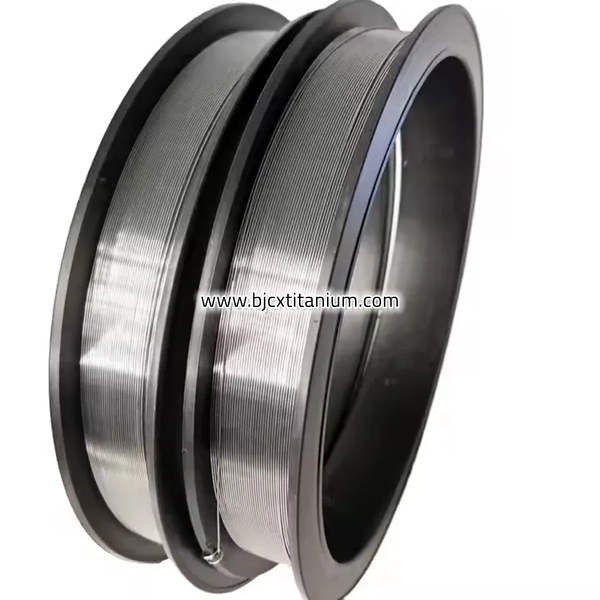
Aerospace Titanium Alloy Wire
2. Stable Service Across Extreme Temperatures
3. Full-Range Precision Tolerance Control
4. Multiple Surface Finishes for Versatile Applications
5. Fully Traceable with Accredited Certification
In the aerospace field, weight reduction, resistance to extreme temperatures, and high reliability are the primary considerations in material selection. Thanks to its exceptional advantages-such as high specific strength, excellent corrosion resistance, and a low coefficient of thermal expansion-titanium alloys have become the material of choice for aircraft structures, propulsion systems, and critical components of spacecraft.
Characteristics of Core Grades and Material Advantages
1. Grade 5 (Ti-6Al-4V)
This grade accounts for more than 70% of global aerospace titanium alloy consumption. Its tensile strength reaches 900–1,100 MPa, with a density of only 4.43 g/cm³ (approximately 60% lighter than steel), and it can operate reliably over a wide temperature range from −253°C to 316°C. Suitable for high-stress components, such as engine fasteners, control cables, and structural bolts.
2. Grade 23 (Ti-6Al-4V ELI)
The ELI (Extra Low Interstitial) grade achieves a significant improvement in low-temperature ductility and fracture toughness through stringent control of oxygen, nitrogen, and hydrogen content. Its fatigue strength reaches 550 MPa at 10⁷ cycles and it complies with the ASTM F136 biocompatibility standard, making it suitable for mixed‑application scenarios that simultaneously demand aerospace and medical cleanliness, such as cryogenic fuel tank fasteners and housings for implantable aerospace sensors.
Aerospace Titanium Wire – Dimensions, Grades & Application Parameters
| Grade (ASTM/AMS) | Diameter Range (mm) | Tolerance (mm) | Typical Applications | Key Property Required |
|---|---|---|---|---|
| Grade 5 (Ti-6Al-4V) | 0.1 – 12.7 | ≤1.0mm: ±0.005; >1.0mm: ±0.01 | Engine fasteners, tie rods, control cables | High tensile strength, creep resistance |
| Grade 23 (Ti-6Al-4V ELI) | 0.3 – 10.0 | ≤1.0mm: ±0.005; >1.0mm: ±0.01 | Cryogenic tank bolts, medical-aero hybrid devices | Cryogenic ductility, high fatigue life |
| Grade 5 (Annealed) | 0.5 – 12.7 | ±0.01 | Flexible cable shielding, structural brackets | Formability, stress relief |
| Grade 23 (Age-Hardened) | 0.8 – 8.0 | ±0.008 | Cyclic load springs, antenna deployment mechanisms | Fatigue strength (≥550 MPa @10⁷ cycles) |


Summary of the material's core advantages:
Its specific strength exceeds that of 304 stainless steel and Inconel 718.
Resistant to corrosion by seawater, hydraulic oil, fuels, and most organic media.
Non-magnetic, with a coefficient of thermal expansion comparable to that of carbon fiber composites, thereby reducing thermal stress mismatch.3. Typical application scenarios and their corresponding dimensions and performance requirements
1. Aircraft structural components
Grade of material used: Grade 5
Wire diameter: 1.0mm – 6.0mm (common fasteners and tie rods)
Performance requirements: Tensile strength ≥900 MPa, yield strength ≥825 MPa, elongation ≥10%
Typical components: flight control system pushrods, engine pylon bolts, and lightweight airframe rivets.
Weight reduction: Compared with steel components, it achieves a 30–50% weight reduction, significantly improving fuel efficiency.
2. Propulsion System
Material grade: Grade 5 (high-temperature zone)
Wire diameter: 0.5mm – 4.0mm (for turbine blade cooling passages)
Performance Requirements: Thermal cycling resistance, oxidation resistance up to 600°C (short-term)
Typical components: turbine blade fastening wires, combustion chamber support springs, and exhaust system tie wires.
Advantages: Maintains structural integrity under cyclic thermal stress and reduces rotor inertia.
3. Space Exploration (including cryogenic environments)
Recommended grade: Grade 23 (preferred)
Wire diameter: 0.3mm – 3.0mm (for springs and connectors)
Performance Requirements: Low-temperature elongation retention ≥90% (-253°C), fatigue life ≥10⁷ cycles.
Typical components: satellite antenna release springs, liquid hydrogen fuel tank fasteners, and rocket engine fuel line tie wires.
Compliance: Meets NASA's low outgassing and radiation resistance standards.
4. Our core advantages as a manufacturer
As a titanium alloy wire manufacturer with a vertically integrated production line-covering smelting, rolling, drawing, heat treatment, and precision inspection-we possess the following irreplaceable competitive advantages:
End-to-end quality control: From titanium sponge to finished wire, every melting batch is fully traceable. Each batch undergoes ultrasonic testing (UT), eddy current testing (ECT), and tensile/fatigue testing in accordance with ISO 6892-1 to ensure zero defects both internally and on the surface.
Global certification system: Product compliance with ASTM B348, AMS 4930/4981 (Grade 5), as well as ASTM F136 and AMS 4991 (Grade 23). The facility is certified to NADCAP, AS9100D, and EN 9100, and supports EN 10204 Type 3.2 inspection reports as well as low-temperature impact data.
Engineering collaboration capabilities: offering finite element analysis (FEA)-assisted design, rapid prototyping, and on-site material testing support. We have been providing stable supplies to Boeing, Airbus, and numerous aerospace agencies for more than ten consecutive years.
Why Choose Us
1. Full range of custom size and surface treatment.
We can supply wire rods with non-standard diameters ranging from 0.05mm to 15 mm, as well as six surface finishes: bright drawing, annealing, passivation, and electropolishing, among others. Prestressing treatment is provided to meet specific tension requirements. Meets the demands of highly abrasive environments. The minimum order quantity starts as low as 5 kg, and prototype verification is supported.
2. Rapid Response and Global Logistics Assurance.
Standard-diameter wire is delivered within 1–3 weeks; custom alloys (such as Ti-5Al-5V-5Mo-3Cr) are delivered within 4–6 weeks. Express air freight services worldwide (DHL/FedEx), as well as sea freight for bulk inventory preparation. ITAR/EAR-compliant exports, featuring vacuum-sealed moisture-proof packaging and stainless steel non-magnetic spools to ensure contamination-free long-distance transportation.
3. Lifetime material traceability and technical support.
Each batch of products is accompanied by a heat-number steel stamp and an EN 10204 3.1 or 3.2 certification report. We commit to ensuring that quality records are traceable for 10 years. The after-sales team provides online failure analysis guidance, welding parameter recommendations, and secondary processing training. In the event of in-service failures caused by material issues, we offer free third-party re-inspection and expedited replacement production. In conclusion, whether for high-strength structural components in Grade 5 or for low-temperature, high-toughness applications in Grade 23, Chenxin Titanium Industry can provide a one-stop solution encompassing material design, precision wire drawing, and globally compliant delivery. We are not only a supplier of wire materials, but also your trusted partner for lightweight materials in aerospace projects.
Request a Quote
Email:bjcxtitanium@gmail.com
Whatsapp:+8613571718779
Hot Tags: aerospace titanium alloy wire, China aerospace titanium alloy wire manufacturers, suppliers, factory
Previous
Gr5 Titanium Alloy WireNext
Nickel WireYou Might Also Like


Send Inquiry