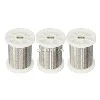
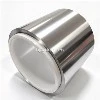
Grade 12 titanium foil, also known as Grade 12 according to the American standard (UNS R53400), corresponds to domestic TA10. Its alloy composition is Ti-0.3Mo-0.8Ni, and the product complies with the ASTM B265 standard.It is a molybdenum and nickel enhanced low-alloy titanium thin strip. However, unlike pure titanium foils such as Grade 1 and Grade 2, Grade 12 are special resistant to crevice corrosion, providing better corrosion resistance in reducing media. Grade 12 is a low-interstitial alloy of titanium with palladium used for chemical processing applications where sulphuric acid process strengthening is needed. In such environments as high temperature chloride salt solutions, brine in geotherma wells, weak reducing acids, pure titanium 2 is susceptible to localized corrosion and penetration while Grade 12 can be utilized in stable condition. It has good plasticity in annealed condition with a material density 4.51g/cm³, which can be bent, stamped and welded. It is high grade ultra thin corrosion resistant material widely used in chemical, geothermal, seawater desalination, etc.
Usually this titanium foil will be from 0.05 to 0.5mm thick, and 50 to 600mm wide, and easily slit and cut into strips. The manufacture of ultra-thin gauges is not trivial since the rolling must be very well controlled as to the exerted pressure, the flatness and the surface finish in order to not have troubles related to the presence of pinholes, scratches and non- uniform thickness. Normal pure titanium foil is only applicable for oxidative environment, because it has a large risk of pitting and perforation in high temperature chloride containing crevise situation. Gr12, which incorporates molybdenum and nickel, is specifically developed for such harsh environments. In practical applications, it is commonly used as a geothermal heat exchange lining, desalination corrosion-resistant isolation membrane, and can also be stamped into flange sealing gaskets for chemical pumps and valves, or serve as a corrosion-resistant conductive substrate for electrolytic equipment.
There are few factories in the industry capable of stable mass production of Gr12 foil thinner than 0.1mm, as many titanium material manufacturers can only produce thick plates. In the past, such ultra-thin specifications were mostly imported. In recent years, with the increase in geothermal and chemical projects in Europe, overseas customers' procurement volumes have risen year by year, and their requirements are also very strict. Meeting the required chemical composition is only part of the job. The foil must also have a clean surface, consistent thickness, and no pinholes. Manufacturing calls for precision rolling equipment and clean slitting areas. Every production batch should be checked for its structure, strength, and resistance to corrosion, with full material certificates supplied at delivery.
Choose the grade based on how the foil will be used. For normal air exposure or clean, room-temperature water, Gr2 titanium is generally adequate. For hot brine, chloride-filled gaps, or mildly reducing acidic conditions, Gr12 is usually the better option. Welding requires the same careful shielding used with pure titanium: poor protection can make the seam brittle and leave it less resistant to corrosion. Currently, domestic manufacturers can provide on-demand cutting and accept small-batch trial orders, helping overseas clients reduce initial testing costs. Gr12 titanium foil is gradually gaining traction in Europe and Southeast Asia's high-end industrial markets.
Request a Quote
Email:bjcxtitanium@gmail.com
Whatsapp:+8613571718779