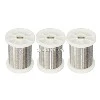
The body-centred cubic Ti-6Al-4V alloy (known as Grade 5 ELI titanium alloy globally) is a widely employed standard in the medical industry and described in the ASTM F136 standard which is the standard by American Society for Testing and Materials and is recognized by TUV SUD. It is designed for the long-term (>30 days) implant of medical devices in the human body.The only corresponding material in the industry is ASTM F136 Grade5 ELI (Ti-6Al-4V ELI) low-interstitial titanium alloy, which is completely different from the ASTM B348 industrial-grade general titanium standard. This standard sets stringent thresholds for raw material purity, interstitial elements, mechanical properties, surface precision, and resistance to body fluid corrosion, which far exceed industrial standards. It is a globally recognized authoritative compliance standard for the export of medical devices and clinical implant products from Europe and the United States, and is also the core substrate basis for high-end minimally invasive medical, orthopedic, and dental implant devices.
ASTM F136 Grade 5 ELI titanium wire has the full spectrum of medical benefits that regular titanium wire cannot provide by any means. This grade is a modification of the standard ASTM B348 pure titanium wire with a reduced amount of impurities like oxygen, carbon, and iron. The low-interstitial formula ensures that the material's biocompatibility meets top medical standards. After implantation into the human body, it does not leach out metal ions, causing no allergies, no rejection, and no inflammatory stimulation. It can stably adapt to human body fluids, soft tissues, and bone environments for a long time. At the same time, the material combines ultra-high strength and excellent fatigue resistance. Its tensile strength far exceeds that of pure titanium materials, enabling it to withstand the reciprocating tensile and bending stresses caused by human movement for a long time. Long-term implantation results in minimal deformation, fracture, and loosening, completely solving the industry pain points of ordinary medical titanium wires, which are insufficient in strength and prone to fatigue failure.
In the field of precision medical manufacturing, ASTM F136 titanium wire is a rigid core material for high-end implant devices. The product undergoes precision drawing and vacuum stress relief processes, resulting in uniform wire diameter, mirror-like surface finish, no burrs or cracks, stable bending and shaping performance, and adaptability to various precision mold processing and minimally invasive clinical surgeries. The ultra-fine specifications of 0.1–0.5mm are widely used in dental orthodontic wires, implant fixation wires, and minimally invasive medical implant accessories; the specifications of 0.5–2.0mm are mainly used for orthopedic micro-fixation nails, soft tissue repair fixation wires, and minimally invasive surgical implant structural components. Relying on the strict American standard system, ultimate safety, and mechanical stability, ASTM F136 titanium wire has become the preferred substrate material for global medical device manufacturers seeking overseas certification and mass production of high-end medical equipment, firmly occupying the mainstream market for precision implant titanium materials.
Request a Quote
Email:bjcxtitanium@gmail.com
Whatsapp:+8613571718779