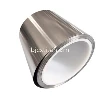
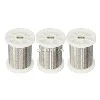
Grade 9 titanium strip, national standard grade TA18, with a composition of Ti-3Al-2.5V, belongs to the near alpha titanium alloy and follows the ASTM B265 standard. It is often regarded as a compromise material between pure titanium and Grade 5 in the industry. In the design process of this reverse engineering project when we was designed the A-check frame we based in the typical architecture used by the main static bracket.
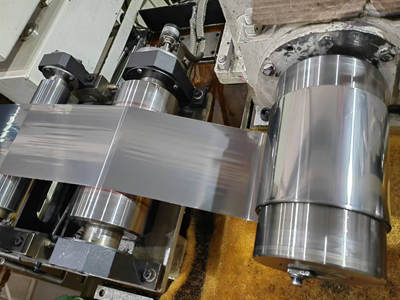
Common to all of these systems is the need to remove or neutralize the residual stress built into the frame strips from the stamping releases. If this is not achieved, the STRIP will recover back to its original (tan) dimension, causing the bracket to loosen while under cyclic stress loads.
Initially many buyers opt for Grade 5 titanium material; Grade 5 can be very hard and at high hardness is prone to cracking when being thin strip stamped and/or bent. +Pure titanium has good ductility, but its strength is not enough to bear the load.Grade9 just fills this gap, balancing strength and cold working performance. This is also the reason why its demand in the precision manufacturing field has continued to rise in recent years.
In terms of performance, Grade 9 has significantly better tensile strength than pure titanium Gr1 and Gr2, while retaining good plasticity and welding performance. It can be put into the annealed state and directly processed in the same without requiring a complex heat treatment. It is still resistant to hydrogen embrittlement, well resistant to corrosion from seawater, chloride and weak acid, not magnetic, and has a long-term operating temperature of approximately 315 ℃. It is suitable for alternating loads, humid and salty working conditions. In rolling production, Gr9 titanium strips have high requirements for shape control. Thin gauge strips are prone to warping and edge waves during rolling, and burrs are easily generated during narrow slitting. High requirements are placed on rolling mills, leveling, slitting equipment, and process experience, and not all titanium material factories can achieve stable mass production.
The mainstream supply thickness range on the market is 0.1-2.0mm, with a width of 5-300mm. It can be supplied in mother rolls or cut into narrow strips or fixed length sheets according to customer drawings. There are significant differences in the corresponding scenarios for different specifications: 0.1-0.3mm ultra-thin tapes are mostly used for sensor lining and precision elastic gaskets; 0.3-0.8mm specifications are mostly used for aviation hydraulic pipeline wrapping and instrument sealing components; 0.8-2.0mm thick tape, commonly used for oil and gas anti-corrosion fixtures and lightweight support components.
We are now the prime focus for 4 major markets: aviation hydraulic systems, marine equipment, new energy test equipment, and precision instruments. Overseas customers (primarily the United States and Europe) call for highly stringent tolerances and surface condition with an insistence on material certificates. More so when mass production on certain projects is an important factor – projects pushed to use of Grade 9, which prioritises stability of forming and minimal degradation of the welding joint performance. When making out procurement decisions, to mention not only confirming the brand standards, it is equally essential to confirm the delivery status, surface treatment method, and trim tolerance as well as communicating stamping / welding processes in advance to avoid batch defects in later processing processes. Selecting and Implementing small-batch narrowband customization and Process support are also important for customers who are in the sample stage.
Request a Quote
Email:bjcxtitanium@gmail.com
Whatsapp:+8613571718779