The current biggest observation in the titanium market is its polarization: it's not just about being cheap to sell, but clearly defining value. There is an abundance of ordinary civilian-grade titanium production, companies bashing each other with prices, the profit less and less. However, aerospace, healthcare, high-end consumer electronics and specialty titanium alloys are in tune with steady demand.
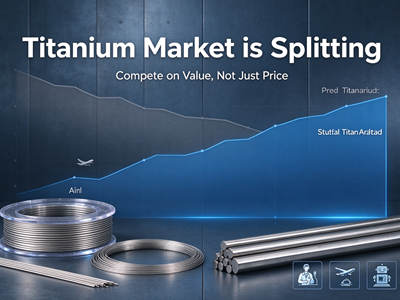
The reality is, the materials business for Ti is no longer only about price wars. Instead of head-to-head battles over general-purpose materials it needs to move into specialized applications. Products in the low-end which compete on unit cost have historically been hard to profit from, while the middle to high-end verticals-companies providing high-performance materials to the aerospace, medical implants, hydrogen energy and marine engineering sectors-already face inherent technical challenges. For best-in-class products such as (folding screen hinges, robotic structural components, and medical implants) are materials merely the base; actual drives are processes underpinned by validation and delivery. When pursuit the business opportunity that matters most is not the unit price (per kilo) but the service life, weight reduction, stability and the timelines to certification all of which your customers are already looking for so you can always negotiate more.
Most of the clients have no inclination toward using titanium because of the challenges of the processing. Titanium is difficult to machine, has low material yield, and causes significant tool wear. In the past, we mainly relied on clients providing drawings for us to deliver accordingly. Moving forward, we can no longer just sell materials-we must help clients solve implementation issues. Whether it's precision forming, compatibility with 3D printing, or surface treatments like anodization and sandblasting/polishing, along with stable supply from small to large batches and traceable control, these are all critical needs for clients. Only by transforming titanium from a "hard-to-machine material" into a stably mass-produced component can we enter the high-growth track.
Another crucial point: many products were not initially designed with titanium in mind. Last decade, there has been an upsurge in demand for lightweight, low-altitude equipment-from industrial robots and drones to high-end wearables. In most applications, titanium is an excellent substitute for stainless steel and aluminum because of its high strength and lightweight properties. Additionally, the ability of 3D printing to create complex integrated structures reduces assembly needs and performance has improved. Of course, this is especially true in consumer terms-watches, eyewear and outdoor gear. Titanium isn't just a structural component; its tactile feel, corrosion resistance, and skin-friendly characteristics are selling points in themselves. We can't wait for clients to inquire-we must proactively collaborate with designers and OEMs to refine solutions.
The old perception of titanium in the market must also be gradually changed. Many still believe that titanium is only used in military and aviation sectors, being expensive and difficult to process. In reality, the price of sponge titanium has already dropped significantly, and with mature processes such as powder metallurgy, precision rolling, and additive manufacturing, the threshold for civilian applications has lowered considerably. Titanium is not just substitute for steel or aluminium but is achieved through structure, and is different from that through craftsmanship. The service also includes post-supply inspection, certification, and technical support.
The key opportunities in the coming period will primarily lie in these areas: consumer electronics structural components, low-altitude equipment, humanoid robots, medical devices, hydrogen energy, marine corrosion-resistant components, and 3D printing consumables. These clients are willing to pay for stable and reliable solutions. Where conditions permit, leveraging the Baoji Titanium Industry Research Institute for market research and project evaluation can help identify precise positioning and avoid low-end red oceans.
Intervene in product design and gradually shift customer perceptions. Only the companies who able to adapt quickly will adapt to internal competition and new opportunities.
In what follows, the competition will no longer be about the ones that have greater production capacity, or the ones with more furnaces but those that understand the end user scenarios and can get into early-stage design and produce a mass producible solution. In a picture of the future, the titanium industry is set to focus on new growth through value pricing refinement, technical upselling of processing capabilities, and product design in the wholesale market, which will see customer perceptions gradually shift. Only enterprises that adapt first can withstand internal competition and seize new opportunities.
Chenxin specializes in titanium wire, titanium welding wire, ultra-fine titanium wire, 3D printing titanium wire, medical titanium wire, medical titanium rods, titanium alloy rods, and other titanium and titanium alloy products, serving various industries such as medical, aerospace, robotics, and additive manufacturing.
Request a Quote
Email:bjcxtitanium@gmail.com
Whatsapp:+8613571718779